
Impact of Mitochondrial Dysfunction on the Health and Performance of Cloned Horses
Introduction
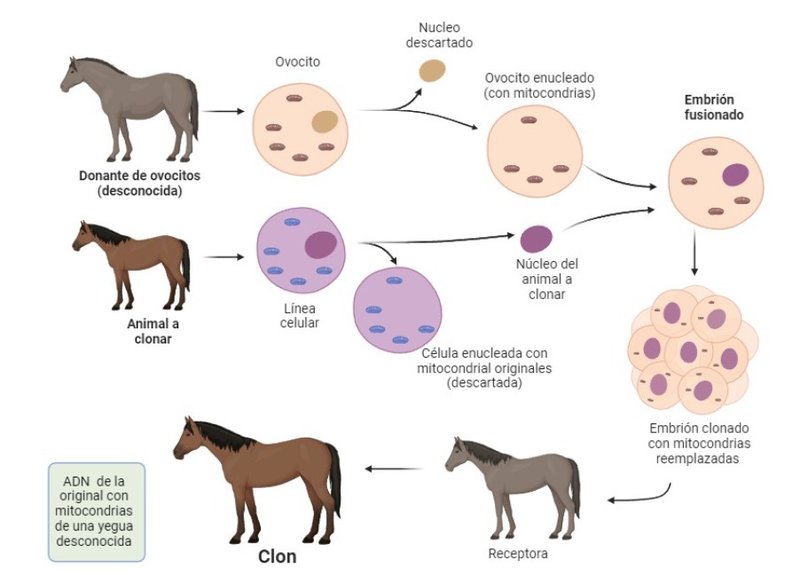
While equine cloning has successfully produced individuals genetically identical to high-value donors, it is not without its challenges. Observations in cloned foals have revealed a higher incidence of health problems — cardiovascular, musculoskeletal, and metabolic — that cannot always be attributed solely to incomplete nuclear reprogramming. Our research focuses on the critical role of mitochondria, the cell's “powerhouses,” in these anomalies. During cloning, the nucleus of the donor somatic cell is transferred to an enucleated oocyte, which provides its own mitochondria. This disparity between the nuclear DNA (from the donor) and the mitochondrial DNA (from the recipient oocyte) can generate an incompatibility, altering mitochondrial function and affecting the animal's overall health.
Working Hypothesis
Our main hypothesis is that mitochondrial dysfunction, resulting from the incompatibility between the nuclear genome and the mitochondrial genome of different origins in cloned horses, significantly contributes to the physiological and pathological anomalies observed in these animals. We believe that this incompatibility affects the efficiency of the electron transport chain, increases oxidative stress, and compromises ATP production, which translates into lower performance and greater susceptibility to disease.
Future Work and Methodology
- Genomic characterisation of the mitochondrial profile using high-throughput sequencing to identify specific variants and haplogroups in cloned animals and their founders.
- Comparison between clones and founders to determine whether heteroplasmy or genomic incompatibility contributes to the observed dysfunctions.
- RNA-seq analysis to compare expression profiles of nuclear and mitochondrial genes related to mitochondrial function in both groups.
- Physiological monitoring of cloned horses, correlating performance parameters with markers of mitochondrial dysfunction.
Where We Head
- Identification of early biomarkers of mitochondrial dysfunction to allow intervention and improve animal welfare.
- Investigation of mitigation strategies, such as selecting oocyte donors with compatible mitochondrial haplogroups.
- Optimisation of cloning protocols to produce healthier animals with improved performance.
- Use of cloned horses with mitochondrial dysfunction as a model for the study of human mitochondrial diseases.
Selected publications
- Azcona F. et al. (2020) Impact of reproductive biotechnologies on genetic variability of Argentine Polo horses. Livestock Science.
- Azcona F., Molina A., Demyda-Peyrás S. (2025) Genomic-Inbreeding Landscape and Selection Signatures in the Polo Argentino Horse Breed. IJMS 26.
- Karlau A. et al. (2023) The influence of foreign lineages in the genetic component of reproductive traits in Criollo Argentino mares: a 30-year study.
See the full publication list →
Research lines behind this project
Team
The project is led by Dr. Sebastián Demyda Peyrás with Dr. Florencia Azcona and Ayelén Karlau, in collaboration with Dr. Pablo Trigo (Equine Morphokinetic Lab, National University of La Plata) and with Argentine polo breeding operations that provided the cloned and non-cloned cohorts.
Status and funding
Ongoing. A poster on genetic variability in cloned polo horses was presented at ISAG 2025 in Daejeon. Sample collection and the comparative performance analysis are in progress.
Interested in collaborating on this project, or in a PhD or Masters project around it? Write to sebass@uco.es.
Contact


